Most people put off sending important letters — not because they don't know what to say, but because the process feels like a project. Find the right template. Get the tone right. Format it properly. Print it. Find stamps. Get to the post office before it closes. That's a half-day task for something that should take minutes.
AI letter writing tools have collapsed that timeline. With the right platform, you can describe what you need, get a polished draft, and have a physical letter in the mail — all in about 60 seconds.
This guide walks through exactly how that works, what types of letters AI handles well, and how WriteToMail combines AI drafting with USPS physical delivery so you never have to touch a printer or buy a stamp.
Table of Contents
- What Is an AI Letter Writer?
- What Types of Letters Can AI Write?
- How the AI Drafting Workflow Works on WriteToMail
- From Draft to Mailbox: The End-to-End Process
- Who Uses AI Letter Writers?
- Why Physical Mail Still Matters in 2026
- AI Letter Writer vs. DIY Templates vs. Hiring an Attorney
- Sources
- FAQ
What Is an AI Letter Writer?
An AI letter writer is a tool that generates professional letter drafts based on a prompt or description you provide. Instead of starting from a blank page, you describe your situation — "I need to demand payment from a contractor who owes me $3,200" or "I want to file a formal complaint about a defective appliance" — and the AI produces a complete, structured letter.
The best tools don't just fill in a template with your name and dollar amount. They adapt tone, structure, and language to the specific situation. A demand letter needs assertive, legally precise language. A cover letter needs to be professional but warm. A formal complaint should be firm without being inflammatory. Good AI drafting handles those distinctions automatically.
What separates an ai letter writer online from basic document generators is the combination of natural language understanding and formatting intelligence. You don't need to know legal terminology. You don't need to understand the proper structure of a cease and desist letter. You describe your situation in plain language, and the AI translates it into the right format.
What Types of Letters Can AI Write?
AI handles a wide range of letter types well. Here are the most common use cases:
Demand Letters
A demand letter formally requests payment, action, or resolution — and puts the recipient on notice that legal action may follow. AI writers excel at demand letters because the structure is consistent: identify the parties, state the amount or action owed, set a deadline, and outline consequences.
If you're owed money by a client, contractor, or tenant, a well-drafted physical demand letter carries significantly more weight than an email. Learn more about what makes these letters effective in what is a demand letter and when to use one.
Cease and Desist Letters
These letters demand that an individual or entity stop a specific behavior — trademark infringement, harassment, unauthorized use of content, or breach of a non-compete agreement. AI can draft the core language, but always have an attorney review cease and desist letters before sending if the legal stakes are high.
Formal Complaint Letters
Complaint letters to businesses, landlords, contractors, or service providers benefit from a structured, professional tone that email rarely achieves. AI writers generate letters that are specific, calm, and credible — qualities that get results.
Cover Letters
A surprising use case, but a powerful one. Job seekers who send a physical cover letter via USPS stand out immediately. AI can tailor a cover letter to a specific job posting and company with just a few details. Combined with a mailing service, you can send physical applications that 99% of candidates skip entirely.
Business Correspondence
Vendor notices, client communications, payment reminders, lease termination notices — all of these follow predictable formats that AI handles cleanly.
How the AI Drafting Workflow Works on WriteToMail
WriteToMail's AI drafting workflow is built for people who know what they want to say but don't want to figure out how to say it formally.
Here's how it works:
Step 1: Describe your situation. You type a plain-language description of what you need. "I'm a freelancer owed $4,500 by a client who hasn't responded to three invoices. I need a demand letter giving them 10 days to pay before I take legal action." That's enough.
Step 2: AI generates a complete draft. The platform produces a polished, properly formatted letter — correct salutation, professional body paragraphs, clear deadline, appropriate closing. The language matches the letter type.
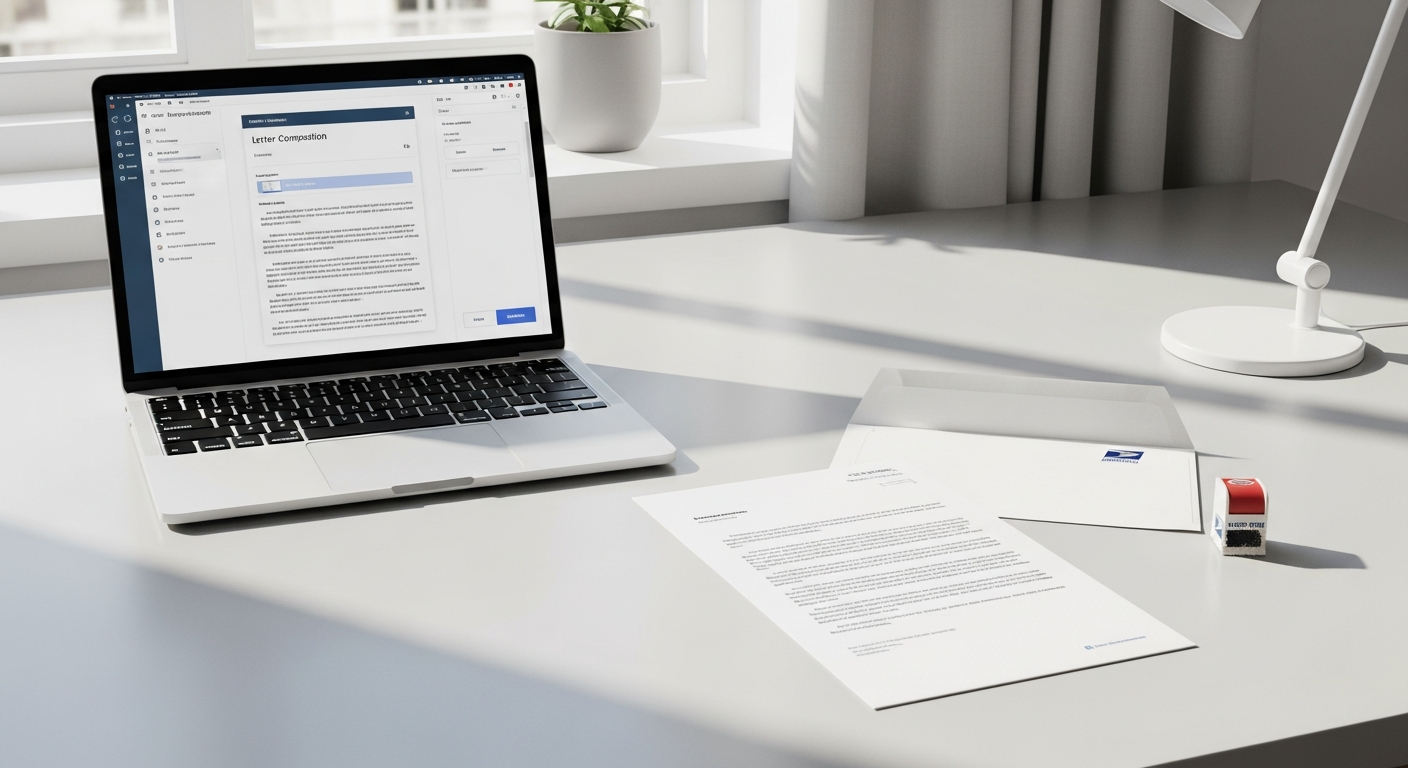
Step 3: Customize using the rich text editor. You can edit any part of the letter using WriteToMail's editor, which supports font, style, and color customization. Add your company letterhead style. Adjust the tone. Change a date. The AI gives you a strong starting point; the editor gives you full control.
Step 4: Enter recipient details. Type the recipient's name and mailing address. WriteToMail handles formatting.
Step 5: Submit and send. WriteToMail prints, envelopes, stamps, and mails your letter via USPS First-Class Mail. You're done.
No printer. No stamps. No post office. The entire process — from blank page to letter in the mail — takes about 60 seconds for someone who knows what they want to communicate.
If you already have a draft and just need it mailed, the platform also supports uploading and mailing a PDF letter directly, so you're never forced to retype something you've already written.
From Draft to Mailbox: The End-to-End Process
Understanding the full workflow helps set expectations, especially for time-sensitive letters.
What Happens After You Submit
Once you finalize and submit your letter, WriteToMail handles:
- Printing: Your letter is printed on quality paper at a SOC 2 compliant facility.
- Enveloping and stamping: The letter is folded, inserted, and sealed in a standard envelope with proper postage applied.
- USPS handoff: Your letter enters the USPS First-Class Mail stream, which delivers to most US addresses within 3–5 business days.
The entire platform is SOC 2 compliant for data security, and WriteToMail also supports HIPAA-compliant physical mail — making it suitable for healthcare-adjacent correspondence that needs to meet regulatory standards.
For High-Volume Senders
If you need to send the same letter (or a personalized variation) to hundreds or thousands of recipients, WriteToMail supports bulk mailing via CSV upload. Upload a spreadsheet with recipient names, addresses, and any variable fields — like amount owed, account numbers, or due dates — and the platform handles mail merge automatically. Each recipient gets a personalized physical letter.
This is the workflow used by accounts receivable teams, law firms sending client notices, property managers issuing lease reminders, and any organization doing large-scale correspondence. For a detailed look at how this works, see the guide on how to send bulk mail without going to the post office.
Who Uses AI Letter Writers?
The range is broader than most people expect.
Individuals dealing with disputes — an unpaid security deposit, a contractor who didn't finish work, a landlord ignoring maintenance requests — use AI letter writers because they can't afford an attorney for every problem and don't know how to structure formal correspondence.
Freelancers and small business owners send demand letters for unpaid invoices regularly. Getting the tone right matters. Too aggressive and you damage the relationship; too soft and nothing happens. AI drafting hits the professional middle ground.
Law firms use platforms like WriteToMail to streamline client correspondence — sending formal notices, demand letters, and legal documents via physical mail at scale without maintaining in-house printing infrastructure. WriteToMail has a dedicated workflow for law firms at writetomail.com/for-law-firms.
HR teams and hiring managers sometimes use formal mailing for offer letters and sensitive employment communications that benefit from physical documentation.
Property managers and landlords send pay-or-quit notices, lease terminations, and entry notifications by USPS because physical mail is legally required or preferred in most jurisdictions for landlord-tenant notices.
Why Physical Mail Still Matters in 2026
Email is easy to ignore. A physical letter is harder to dismiss, and in legal contexts, it creates a paper trail that email often doesn't. Several reasons physical mail remains the right choice for formal correspondence:
Legal weight. Courts and dispute resolution processes give physical letters more evidentiary credibility. A demand letter sent via USPS — especially with tracking — creates a record that the recipient was formally notified.
Open rates. Physical mail open rates consistently outperform email in business-to-consumer contexts. According to USPS research, direct mail achieves household contact rates above 90%, compared to email open rates that average under 30% for most industries.
Deliverability. Email inboxes have spam filters, promotion tabs, and inbox zero habits working against you. A letter in someone's physical mailbox gets seen.
Psychological impact. A printed letter signals seriousness. For demand letters, cease and desist notices, and formal complaints, that signal matters. Recipients treat physical mail differently than a strongly worded email.
For a broader look at the options available when you need to send formal correspondence without leaving home, the guide to sending physical mail online covers the full landscape.
AI Letter Writer vs. DIY Templates vs. Hiring an Attorney
These three approaches represent different tradeoffs. Here's how they stack up for common letter types:
DIY Templates
Free templates are widely available, but they're generic by design. You spend time finding one, figuring out what to change, and hoping the language is appropriate for your jurisdiction and situation. For simple letters, templates work. For anything with legal stakes, generic language can hurt more than help.
Hiring an Attorney
For letters with real legal consequences — complex cease and desist situations, letters that precede litigation, or anything involving significant money — an attorney review is worth the cost. But attorney fees for drafting a single demand letter typically range from $150 to $500+, and many disputes don't justify that spend. According to the American Bar Association's legal access research, millions of Americans face legal problems each year without professional help primarily because of cost.
AI Letter Writer Online
AI sits in the productive middle. It produces professional, structured letters in seconds. It adapts to your specific situation rather than giving you boilerplate. And when combined with a platform like WriteToMail, it delivers a physical letter via USPS without any additional steps. The cost is a fraction of attorney fees, and the turnaround is measured in seconds rather than days.
The right choice depends on stakes. For routine demand letters, formal complaints, cover letters, and standard business correspondence, an AI letter writer online handles the job well. For letters that directly precede litigation or involve complex legal strategy, consult an attorney — but even then, having a polished draft to start from saves time and money.
Sources
- USPS — Direct Mail and Physical Mail Marketing — referenced for physical mail open rates and household contact rates
- American Bar Association — Legal Aid and Access to Justice — referenced for data on Americans facing legal issues without professional help due to cost
FAQ
How long does it take for an AI-written letter to be delivered?
After you submit your letter on WriteToMail, it enters the USPS First-Class Mail stream. Delivery to most US addresses takes 3–5 business days. The drafting and submission process itself takes about 60 seconds.
Do I need any writing experience to use an AI letter writer?
No. You describe your situation in plain language — the AI handles structure, tone, and formatting. You don't need to know legal terminology or formal letter conventions.
Can I edit the AI-generated draft before it gets mailed?
Yes. WriteToMail's rich text editor lets you modify any part of the AI-generated letter — adjust wording, change dates, update amounts, or reformat styling — before it goes to print.
What types of letters does WriteToMail support?
WriteToMail offers AI drafting for any letter type, plus dedicated templates for demand letters, cease and desist letters, formal complaint letters, and cover letters. You can also upload an existing PDF if you've already written your letter and just need it mailed.
Is my letter content secure?
WriteToMail is SOC 2 compliant, meaning your data is handled according to rigorous security standards. The platform also supports HIPAA-compliant physical mail for healthcare-related correspondence.
Can I send the same letter to multiple people at once?
Yes. WriteToMail supports bulk mailing via CSV upload, where each recipient can receive a personalized version of your letter using mail merge variable fields. This is the same workflow used by law firms, property managers, and accounts receivable teams.
What if I already have my letter written in Word or Google Docs?
Export it as a PDF and upload it directly to WriteToMail. The PDF upload and mail workflow handles printing and USPS delivery without any retyping.
Is an AI-generated demand letter legally valid?
A demand letter is a formal written communication, not a legal filing — so there's no requirement that an attorney write it. An AI-generated demand letter sent via USPS has the same legal standing as any other written demand. For letters that precede complex litigation, attorney review is advisable. For most payment disputes and standard complaints, an AI-drafted letter works well.
Can WriteToMail send certified mail?
For details on certified mail options and when they're legally appropriate, see the guide on how to send certified mail online without going to the post office.
How much does it cost to send a letter through WriteToMail?
Pricing details are available at writetomail.com/pricing. Costs vary by plan and volume.