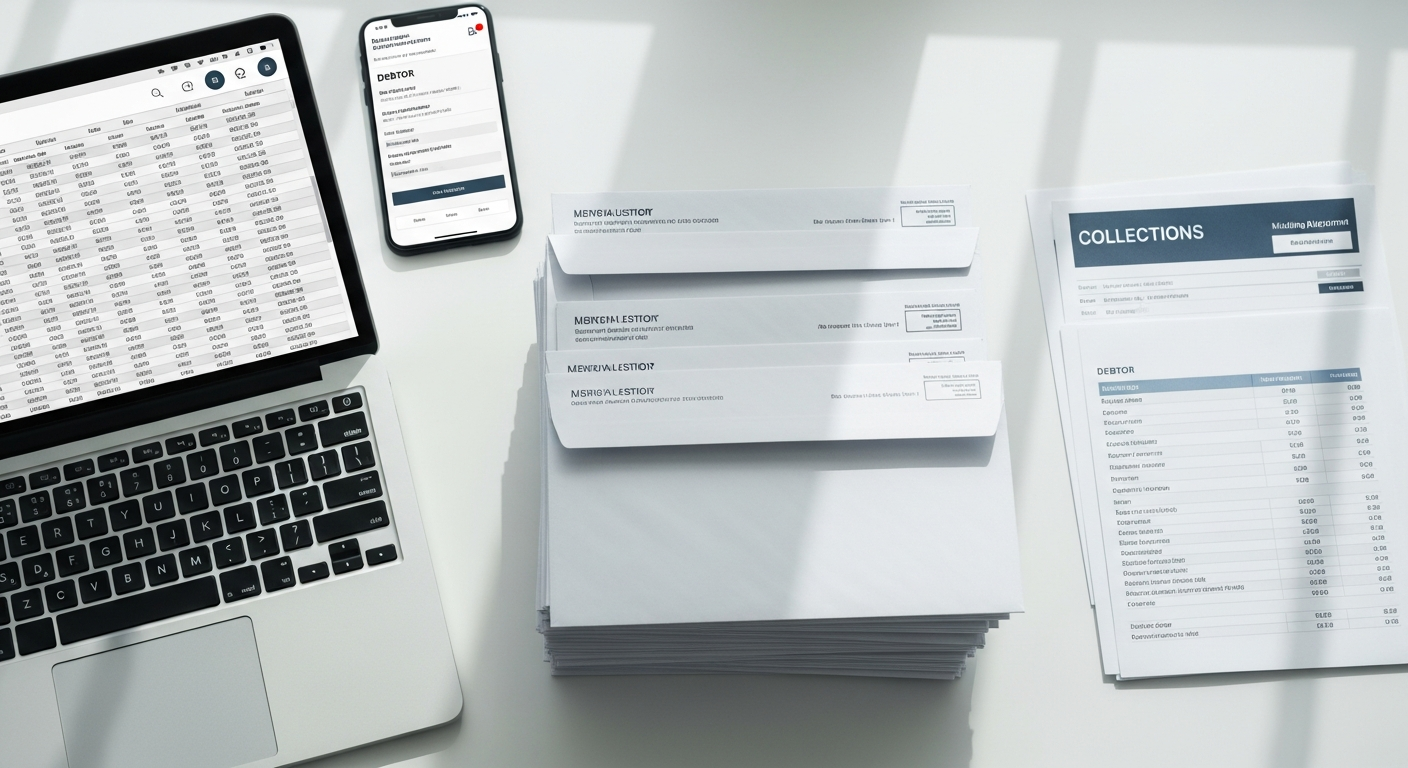
Chasing unpaid accounts is already hard enough. Manually printing, folding, stamping, and mailing collection letters to dozens — or hundreds — of debtors makes it worse. A collections letter mailing service handles the physical delivery side automatically, so your team can focus on what actually moves the needle: escalating the right accounts and recovering revenue.
This guide covers everything accounts receivable teams, collections agencies, and small businesses need to know about automating debt recovery mail — from FDCPA compliance basics to CSV bulk upload workflows and the real ROI of replacing manual processes.
Table of Contents
- What Is a Collections Letter Mailing Service?
- Who Uses These Services?
- FDCPA Compliance Considerations for Physical Mail
- The Three Core Letter Types in a Collections Workflow
- CSV Bulk Upload: Sending to Large Debtor Lists
- Variable Data Personalization in Collection Letters
- The ROI of Automating vs. Manual Collection Mail
- How WriteToMail Powers Collections Mail
- Sources
- FAQ
What Is a Collections Letter Mailing Service?
A collections letter mailing service is an online platform that lets you compose, personalize, and physically send debt recovery notices — past-due letters, final demands, pre-litigation notices — without printing a single page in-house. You upload your content and debtor data, and the service handles printing, enveloping, postage, and USPS delivery.
The distinction from basic mail services matters: a collections-grade platform supports bulk sending via CSV, variable data merge (so each letter contains the recipient's name, account number, and balance), and data security standards like SOC 2 compliance. You're not just mailing letters. You're managing sensitive financial data at scale.
Physical collection letters still outperform digital-only outreach. According to research from NACHA and payment behavior studies, consumers respond more reliably to formal physical mail than email for debt-related communications — particularly for higher-balance accounts where the psychological weight of a paper letter signals seriousness.
Who Uses These Services?
The audience is broader than most people assume:
- Third-party collections agencies managing large debtor portfolios across multiple clients
- In-house accounts receivable teams at mid-size companies handling 30/60/90-day past-due notices
- Small business owners with a handful of non-paying clients who need a formal paper trail
- Law firms handling pre-litigation demand letters and collections work for creditors
- Healthcare billing departments pursuing overdue patient balances (where HIPAA-compliant mail handling is essential)
- Property managers sending rent demand notices before initiating eviction proceedings
Each group has slightly different needs, but the core problem is the same: they need to send formal, documented physical mail at a volume that makes manual processes either impractical or expensive.
FDCPA Compliance Considerations for Physical Mail
The Fair Debt Collection Practices Act (FDCPA) governs how third-party debt collectors communicate with consumers. For physical mail specifically, several rules apply directly.
Key FDCPA physical mail requirements:
- 30-day validation notice: The first written communication must inform the consumer they have 30 days to dispute the debt. This must appear clearly — not buried in fine print.
- No misleading language: The letter cannot imply legal action is imminent if it isn't. Language like "final notice before lawsuit" when no lawsuit is planned can constitute a violation.
- No postcards: The FDCPA prohibits using postcards for debt collection because they expose debt information to third parties.
- Envelope restrictions: The envelope cannot include language that reveals the communication is from a debt collector.
- Cease communication requests: If a consumer requests you stop contacting them in writing, you must comply.
"Third-party collectors face FDCPA liability for every piece of mail they send. The content, timing, and format all matter — and violations can trigger class action exposure." — Common position among consumer finance compliance attorneys.
First-party creditors (businesses collecting their own debts directly) are generally not covered by the FDCPA, but many states have enacted their own consumer protection laws that mirror or exceed federal standards. California's Rosenthal Fair Debt Collection Practices Act applies to first-party collectors, for example.
The practical takeaway: always have your collection letter templates reviewed by a compliance attorney before deploying them at scale. A mailing service automates delivery — compliance is still your responsibility.
The Three Core Letter Types in a Collections Workflow
Most effective collections workflows use a staged letter sequence. Each stage escalates in urgency and formal tone.
Stage 1: Past-Due Notice (30-60 Days)
The first letter is a reminder, not a demand. Friendly but firm. It acknowledges the relationship, states the balance, and provides payment instructions. At this stage, many non-payers respond — they simply forgot or had a temporary cash flow issue.
Key elements: invoice number, amount due, original due date, payment options, and a clear deadline for response.
Stage 2: Second Notice / Final Warning (60-90 Days)
This letter shifts tone. It references the prior notice, states the account is seriously past due, and makes clear that escalation is coming. Collections agencies sometimes add language about credit reporting impact here, which is legally permissible if accurate and not misleading.
Key elements: reference to prior communication, updated balance (including any fees if permitted by contract), firm deadline, escalation consequence.
Stage 3: Final Demand / Pre-Litigation Notice (90+ Days)
This is the most formal document in the sequence. It demands payment by a specific date and states explicitly that failure to respond will result in legal action, referral to a collections agency, or credit bureau reporting. The language needs legal review.
For demand letters sent before litigation, physical USPS delivery matters. Courts often require evidence that formal notice was provided — and a physical mailed letter with a delivery record is far stronger documentation than an email read receipt.
CSV Bulk Upload: Sending to Large Debtor Lists
Manual collection mailing doesn't just cost time — it introduces errors. Wrong addresses, missed accounts, inconsistent formatting. At scale, those errors compound.
CSV bulk upload solves this. You maintain your debtor list in a spreadsheet, export it with the right column headers, and upload it to the mailing platform. The system generates a personalized letter for each row and queues them all for printing and delivery.
A properly structured CSV for collections mail typically includes:
| Column | Description |
|---|---|
FirstName |
Debtor's first name |
LastName |
Debtor's last name |
Address1 |
Street address |
Address2 |
Suite, unit (optional) |
City |
City |
State |
Two-letter state code |
Zip |
5-digit ZIP code |
AccountNumber |
Internal account ID |
AmountDue |
Current balance |
DueDate |
Payment deadline |
OriginalCreditor |
If different from sender |
For a detailed walkthrough of formatting and mapping these fields, the guide on variable data mail merge for bulk letters via CSV covers the technical requirements in depth — including how to preview personalized letters before committing to a full send.
Variable Data Personalization in Collection Letters
A generic "Dear Customer" letter performs worse than a personalized one. This isn't just a marketing insight — it applies directly to debt recovery. A letter that addresses the debtor by name, cites their specific account number, and states their exact balance feels official and demands attention.
Variable data mail merge pulls this information from your CSV and injects it into the correct placeholders in your letter template. Every recipient gets a letter that looks individually typed — at zero additional cost per piece compared to a generic version.
Effective variable fields for collections letters:
{{FirstName}}— personalizes the salutation{{AccountNumber}}— makes the debt traceable and non-disputable{{AmountDue}}— states the exact balance (critical for FDCPA compliance){{DueDate}}— creates a concrete deadline{{OriginalInvoiceDate}}— establishes the timeline of the debt{{PaymentURL}}— directs them to your payment portal
The psychology here is straightforward. Specificity signals legitimacy. A letter with your exact account number and balance isn't easy to dismiss as spam or a mistake. It requires a response.
If you're new to this workflow, the complete guide on sending bulk mail online without going to the post office explains the full process — from CSV preparation to USPS delivery — in plain language.
The ROI of Automating vs. Manual Collection Mail
Let's put real numbers to this.
A mid-size AR team sending 500 collection letters per month manually faces:
- Labor: Approximately 2-3 minutes per letter for printing, folding, stuffing, sealing, and stamping. At 500 letters, that's 17-25 hours of staff time monthly.
- Materials: Paper, toner, envelopes, stamps. At current USPS First-Class rates of $0.73 per stamp plus ~$0.30 in materials, each letter costs roughly $1.00+ in hard costs before labor.
- Error rate: Manual processes introduce addressing errors, missed accounts, and inconsistent letter versions — each of which either delays recovery or creates compliance exposure.
Automating that same volume through an online mailing service:
- Zero labor on print/mail tasks — staff upload a CSV and click send
- Per-piece pricing that often comes in competitive with or below DIY materials costs at volume
- Consistent formatting across every letter — no missed placeholders, no wrong-version issues
- Full audit trail — every letter sent, to whom, when
The break-even calculation is typically favorable within the first month for any team sending more than 50-100 letters. Above that threshold, automation pays for itself in labor savings alone — before accounting for faster delivery cycles and fewer errors.
According to a 2023 report by McKinsey & Company, automating repetitive administrative tasks saves finance and operations teams an average of 40% of time spent on those specific processes. Mailing falls squarely in that category.
How WriteToMail Powers Collections Mail
WriteToMail is a SaaS platform built to send physical letters, postcards, and checks entirely online — no printer, no stamps, no post office. For collections teams, several capabilities make it directly applicable:
Bulk mailing via CSV upload: Upload your debtor list as a spreadsheet, map columns to variable fields, and launch a personalized mailing to hundreds or thousands of recipients simultaneously. Each letter is printed, enveloped, and mailed via USPS First-Class Mail individually addressed.
Variable data mail merge: CSV columns like AmountDue, AccountNumber, FirstName, and DueDate map to placeholders in your letter template. Every recipient receives a letter with their specific information — not a generic form letter.
PDF upload and mail: If your legal or compliance team has already approved a letter template, upload the PDF directly and mail it as-is. No need to recreate it in a new editor.
AI-powered letter drafting: Describe the letter you need — "a 60-day past-due notice to a commercial client with a $4,200 balance" — and the platform drafts it. You review, edit, and send.
SOC 2 compliant printing and data handling: Debtor data is sensitive. WriteToMail's SOC 2 compliance means your data is handled with enterprise-grade security standards — a non-negotiable for collections departments and third-party agencies.
Demand letter template: For accounts approaching litigation, WriteToMail's demand letter template provides a formal starting point. Customize it with your specific balance, deadlines, and escalation language, then send it as a physical letter for documented legal notice.
For law firms handling collections work specifically, WriteToMail maintains a dedicated platform for law firms covering demand letters, formal correspondence, and bulk client notifications.
The print and mail workflow is straightforward: compose or upload your letter, enter (or upload) recipient details, and WriteToMail handles everything downstream — printing, folding, enveloping, postage, and USPS delivery. No staff time. No equipment. No post office runs.
Sources
- Federal Trade Commission — Fair Debt Collection Practices Act Text — Full statutory text of the FDCPA, governing third-party debt collector communications including physical mail requirements
- California Legislature — Rosenthal Fair Debt Collection Practices Act (Civil Code §1788) — California's first-party debt collection law extending FDCPA-style protections
- USPS — Business Postage Prices — Current First-Class Mail postage rates used in cost calculations
- McKinsey & Company — The Future of Work After COVID-19 — Research on administrative task automation and time savings in finance operations
- NACHA — The Electronic Payments Association — Industry research on payment behavior and consumer response to formal financial communications
FAQ
Does a collections letter mailing service handle FDCPA compliance for me?
No. The platform handles printing and mailing — compliance is entirely your responsibility. The letter content, timing, and format must meet FDCPA requirements (if you're a third-party collector) before you upload anything. Use the platform to deliver compliant letters, not to create compliance from scratch.
Can I send collection letters to hundreds of debtors at once?
Yes. Platforms like WriteToMail support bulk mailing via CSV upload, where each row in your spreadsheet generates a individually personalized, physically mailed letter. A single CSV upload can trigger mailings to hundreds or thousands of recipients simultaneously.
Is physical mail required for debt collection, or can I just email?
Physical mail isn't always legally required, but it's often strategically superior and sometimes practically necessary. Email bounce rates for debtors are high, and email lacks the documented delivery proof that physical USPS mail provides. For final demand letters and pre-litigation notices, courts expect evidence of formal written notice — and physical mail creates that paper trail.
How long does USPS First-Class Mail delivery take for collection letters?
USPS First-Class Mail typically delivers in 2-5 business days domestically. For time-sensitive collection notices with specific response deadlines, factor delivery time into your deadline calculations. Your 10-day response window should start from expected delivery, not the send date.
What happens if a debtor's address is wrong or mail gets returned?
Undeliverable mail is returned to the sender address you provide. If a debtor has moved without updating their address, you'll need to locate the current address through skip tracing or credit bureau data before resending. This is why maintaining clean, verified address data in your CSV matters before launching any bulk send.
Is it legal to send collection letters as postcards?
No — not for third-party debt collectors. The FDCPA explicitly prohibits using postcards for debt collection because the debt information would be visible to anyone handling the mail. Use sealed envelopes for all collection correspondence.
How do I prove a debtor received my collection letter?
USPS First-Class Mail does not include delivery confirmation by default. For critical communications — especially final demand letters — consider requesting USPS Certified Mail with return receipt through your mailing provider, which creates documented evidence of delivery or attempted delivery. Check with your mailing platform on available USPS service options.
Can a small business with just a few past-due accounts use this kind of service?
Absolutely. You don't need hundreds of accounts to justify using an online mailing service. Even sending three or four formal letters without dealing with printers, stamps, and post office trips saves time and creates a more professional paper trail than a DIY envelope stuffed at your desk.