
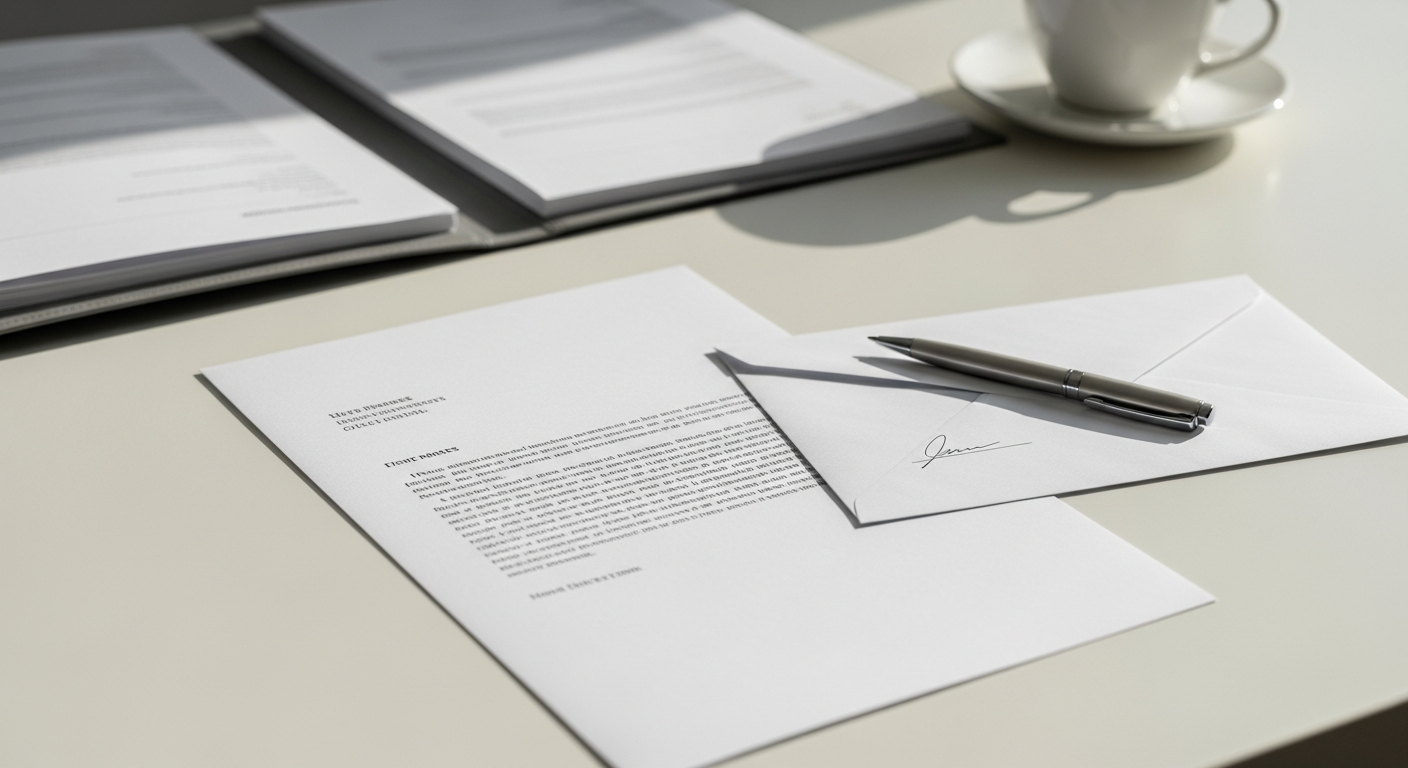
A formal complaint letter template saves you from the most common mistake people make when filing complaints: writing emotionally instead of strategically. The difference between a letter that gets ignored and one that gets a response often comes down to structure, specificity, and how it arrives — not how angry you sound.
This template works for product defects, contractor disputes, insurance claim denials, healthcare billing errors, and poor service experiences. It's designed for anyone who needs to put a business, provider, or contractor on notice — and create a documented paper trail in the process.
The Template
Copy the block below and customize the bracketed fields for your situation.
[Your Full Name] [Street Address] [City, State, ZIP Code] [Email Address] [Phone Number] [Date]
[Recipient Full Name or Department Name] [Company or Organization Name] [Street Address] [City, State, ZIP Code]
Re: Formal Complaint — [Brief Description of Issue] Account/Order/Policy Number (if applicable): [XXXX]
Dear [Mr./Ms./Dr. Last Name or "Customer Service Manager"],
I am writing to formally notify [Company Name] of a complaint regarding [product/service/billing issue] associated with my account/order/policy number [XXXX].
Description of the Problem
On [date], I [purchased / received / experienced] [specific product or service] from [Company Name]. The issue I encountered is as follows:
[Describe the problem in plain, factual language. Include specific dates, product names, model numbers, order numbers, or policy details. Avoid emotional language — state only what happened.]
Prior Attempts to Resolve
I previously attempted to resolve this matter on [date(s)] by [calling customer service / submitting a support ticket / speaking with representative Name]. Despite these efforts, the issue remains unresolved because [brief explanation].
Requested Resolution
I am requesting that [Company Name] take the following action by [specific deadline, e.g., within 14 calendar days of receipt of this letter]:
- [Specific resolution — e.g., full refund of $X, replacement of defective product, correction of billing record, completion of contracted work]
If I do not receive a satisfactory response by [deadline date], I intend to escalate this matter to [relevant authority — e.g., the Better Business Bureau, your state Attorney General's consumer protection office, the applicable state licensing board, or small claims court].
Supporting Documentation
Enclosed with this letter are copies of the following documents:
- [Document 1 — e.g., original receipt or invoice]
- [Document 2 — e.g., email or chat transcript]
- [Document 3 — e.g., photos of defective product]
Please contact me at [email] or [phone number] to confirm receipt and provide a response.
Sincerely,
[Your Signature]
[Your Printed Name]
Section-by-Section Breakdown
Header and Reference Line
The reference line — the "Re:" line — is not optional. It immediately tells the person opening the mail exactly what this letter addresses. Busy customer service managers process dozens of letters a week. A clear reference line routes your complaint to the right department faster.
Include your account, order, or policy number here too. Whoever receives this letter needs to pull your file. Make it easy.
Opening Paragraph
Keep the first paragraph short and direct. State who you are, what the complaint involves, and your identifying account information. Three to four sentences maximum. You are not summarizing the entire letter here — you are orienting the reader.
Avoid starting with "I am very disappointed" or any emotional framing. That signals to the reader that this is a venting letter. You want it to read like a legal notice.
Description of the Problem
This is the most important section. Specificity determines whether your letter is taken seriously or set aside.
Bad: "The product stopped working after a few weeks and it was terrible quality."
Good: "The [Product Name, Model #XYZ], purchased on March 14, 2026 (Order #1089234), stopped charging on April 1, 2026 — 18 days after purchase. The device is under the manufacturer's 90-day warranty outlined in the enclosed documentation."
Dates, dollar amounts, model numbers, and order IDs transform a complaint into a documented claim. Include all of them.
Prior Attempts to Resolve
This section does two things. First, it demonstrates good faith — you tried to resolve this before escalating. Second, it documents a pattern. If you later take this to small claims court or file a complaint with a regulatory agency, this section becomes evidence that the company had multiple opportunities to fix the problem and chose not to.
Name the representative you spoke with if you have that information. Include ticket or case numbers from prior interactions.
Requested Resolution
Be explicit. Vague requests get vague (or no) responses. "I want this fixed" is not a request. "I am requesting a full refund of $247.00 to the original payment method within 14 calendar days" is a request.
Set a firm deadline. Fourteen to 21 calendar days is standard. The deadline creates urgency and establishes a timeline for any follow-up escalation.
State your escalation path plainly. You don't need to threaten — just name where you'll go next. This might be:
- The Consumer Financial Protection Bureau for financial services issues
- Your state Attorney General's office for consumer protection complaints
- The applicable professional licensing board for contractors or healthcare providers
- Small claims court for disputes under your state's dollar threshold (typically $5,000–$10,000)
Supporting Documentation
Never send originals. Send legible photocopies and keep the originals in a folder. Reference every document you're enclosing. An unexplained attachment is often ignored or separated from the letter during processing.
Customization by Industry
Product Defects
In the problem description, include the product name, model number, purchase date, and the specific defect. Reference the warranty terms. State whether the product is a safety hazard, because that changes the escalation path — the Consumer Product Safety Commission handles safety-related defects separately from general consumer complaints.
Contractor Disputes
Attach a copy of the signed contract and itemize specifically which deliverables were not completed or were completed improperly. Reference the contract clauses the contractor violated. For licensing issues, include the contractor's license number and state that you intend to file a complaint with the applicable state licensing board. For disputes involving significant dollar amounts, also consider whether a demand letter for payment is more appropriate than a complaint letter.
Insurance Claim Denials
Reference the claim number, date of denial, and the specific reason stated in the denial letter. Cite the policy language the insurer is relying on, and then cite the policy language that supports your position. Request a written explanation citing the specific policy exclusion. State that you intend to file a complaint with your state's Department of Insurance if the denial is not reviewed. Most state insurance commissioners maintain formal complaint portals that insurers are legally required to respond to.
Healthcare Billing Errors
Include your patient account number, the date of service, the amount billed, and the amount you believe is correct. Attach the Explanation of Benefits (EOB) from your insurer if applicable. Reference the specific line item in the billing statement that is incorrect. For healthcare providers processing complaint correspondence in bulk, the HIPAA compliance considerations for physical mail are more significant than most billing departments realize — this overview of HIPAA-compliant physical mail covers what providers need to know.
Poor Service Experiences
This is the broadest category and the one where specificity matters most. Generic "the service was terrible" letters accomplish nothing. Name the date, location, staff member (if known), and exactly what occurred. Quantify the impact where possible — did you miss a deadline? Incur additional costs? Lose time? Attach any relevant receipts, confirmation emails, or screenshots.
Why Physical Mail Outperforms Email for Formal Complaints
Email is easy to ignore, filter, or forward to a low-priority queue. A physical letter is harder to dismiss. It signals seriousness, it creates a tangible record, and it carries implicit legal weight that email doesn't — particularly when sent via USPS First-Class Mail with tracking.
According to a survey by the Pew Research Center, physical documents remain the preferred format for formal legal and financial correspondence across multiple industries. Companies that receive formal written complaints via physical mail are statistically more likely to escalate them internally than identical complaints submitted through online forms.
A physical letter also strengthens your position if you escalate. Small claims courts, state consumer protection agencies, and the BBB all give more weight to documented paper trails. The letter itself, the postmark date, and any delivery confirmation create a timeline that's difficult to dispute.
If you want to understand more about the legal and practical advantages of sending a formal complaint by mail versus digital channels, this guide on how to write and send a formal complaint letter goes deeper on the documentation strategy.
How to Use This Template: Quick-Start Guide
Step 1 — Gather your documentation first. Pull together every relevant document before you write a single word: receipts, contracts, prior communications, photos, billing statements. The letter should reflect what you have, not what you remember.
Step 2 — Fill in the template. Replace every bracketed field. Read the letter back to yourself and ask: does every sentence state a fact or a request? Remove anything that's purely emotional.
Step 3 — Set a realistic deadline. Count 14–21 days from the likely date of delivery. Don't set a deadline that's already passed or unreasonably short.
Step 4 — Make copies of everything. Photocopy every enclosure. Keep a copy of the final letter for your records before sending.
Step 5 — Mail the physical letter. This is where most people lose momentum. Finding a printer, buying stamps, getting to the post office — these friction points cause people to default to email instead, and that weakens their position.
WriteToMail handles the entire physical mailing process online. Compose or paste your letter, upload your PDF attachments, enter the recipient's address, and the platform handles printing, postage, and USPS First-Class Mail delivery — no printer, no stamps, no post office required. If you've already drafted your letter as a PDF, you can upload it directly and mail it without retyping anything. For situations where you need to send the same complaint to multiple parties simultaneously — such as a corporate headquarters, a regulatory agency, and a local branch — the bulk mailing via CSV upload feature handles that in a single session.
Step 6 — Log the send date. Record when you mailed the letter and when delivery is expected. If you don't receive a response by your deadline, you have a documented timeline for your next escalation step.
One Final Note on Tone
The most effective complaint letters read like they were written by someone who is calm, organized, and prepared to escalate. Not someone who is angry. Not someone who is pleading. Calm and organized.
If the letter sounds like it was written by someone who might actually file in small claims court, the company reading it will treat it accordingly. That's the outcome you're after.
Sources
- Pew Research Center — Internet & Technology Research — referenced in context of physical mail preference for formal correspondence
- Consumer Financial Protection Bureau — cited as escalation resource for financial services complaints
- Consumer Product Safety Commission — cited as escalation resource for safety-related product defect complaints
- Federal Trade Commission — Filing a Consumer Complaint — background resource on consumer complaint escalation paths
- National Association of Attorneys General — Consumer Protection — cited as escalation path for state-level consumer complaints
- American Arbitration Association — Consumer Arbitration — context for dispute resolution alternatives to litigation