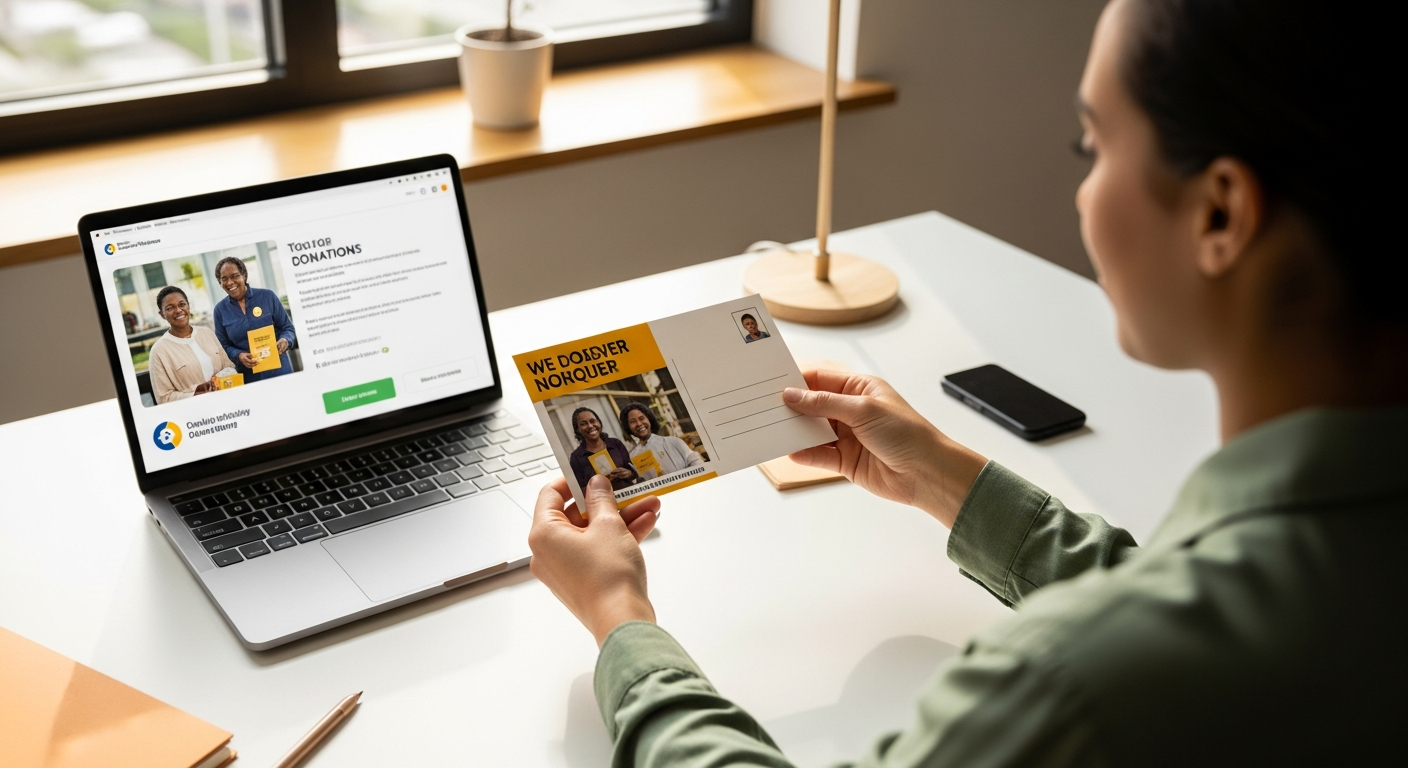
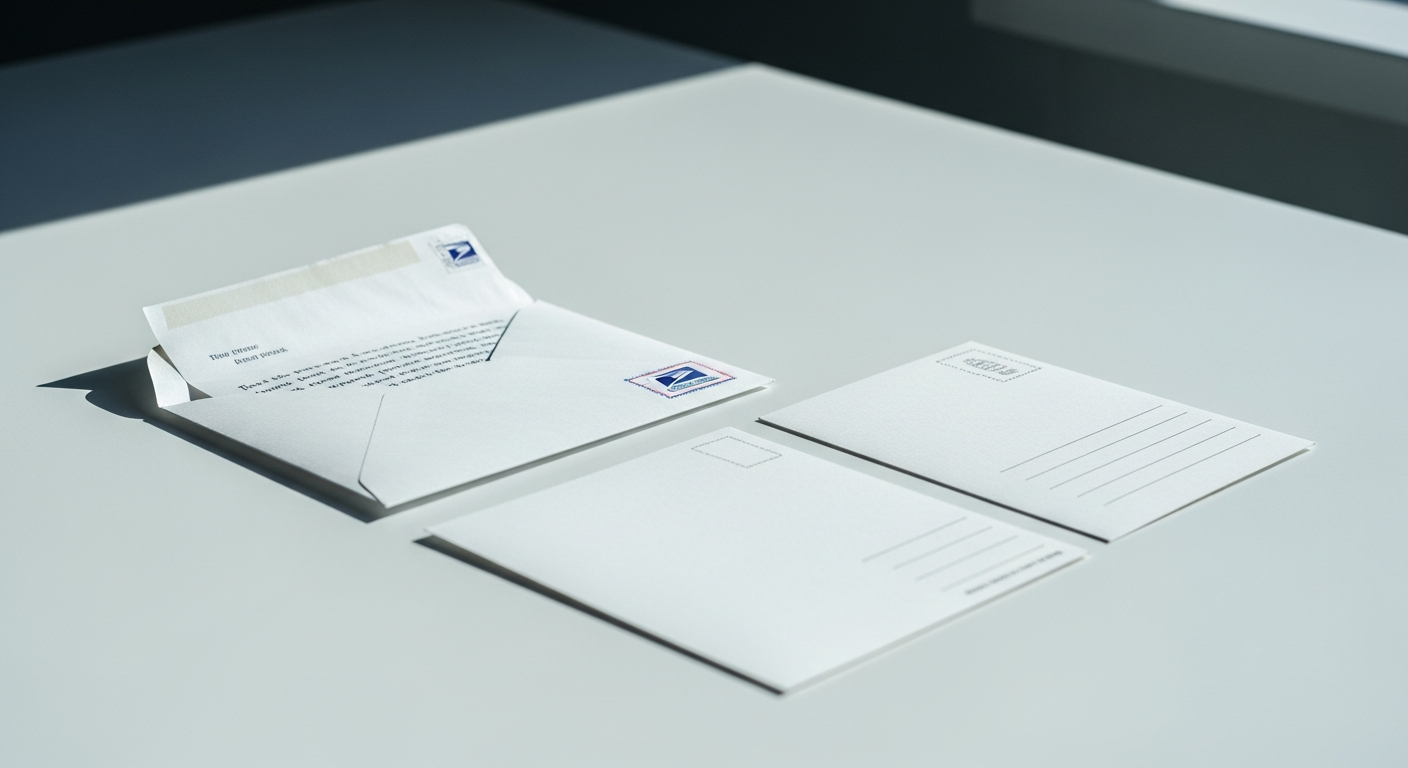
The postcard vs. letter direct mail debate comes down to one thing: what action do you need the recipient to take, and how much friction can you afford? Both formats work. But they work differently, for different goals, with different economics behind them.
Postcards win on visibility and speed. Letters win on credibility and complexity. The mistake most senders make is defaulting to one format out of habit rather than choosing the one that matches their campaign objective.
This guide breaks down both formats by response rate, cost, use case fit, and practical logistics — so you can make a data-backed decision before your next send.
Quick Comparison: Postcard vs. Letter Direct Mail
| Factor | Postcard | Letter (Envelope) |
|---|---|---|
| Average response rate | 4.25% | 4.4% (house list) |
| Average cost per piece | $0.30–$0.75 | $0.50–$1.50+ |
| Postage (standard) | Lower (postcard rate) | Higher (First-Class or bulk) |
| Open rate | 100% (no envelope) | 60–90% (envelope dependent) |
| Best for | Promotions, reminders, re-engagement | Legal, collections, compliance, complex offers |
| Perceived credibility | Low–Medium | High |
| Message length | Short (under ~100 words) | Long (unlimited) |
| Privacy | None — content is visible | High — sealed envelope |
| Production complexity | Low | Medium–High |
| Legal admissibility | Limited | Strong (especially certified) |
The Case for Postcards
What Postcards Do Well
A postcard gets read whether the recipient wants to read it or not. There's no envelope to ignore, no decision about whether to open it. The message is right there — 100% impression rate, guaranteed.
That's the single biggest advantage postcards have over any other format. According to the USPS Household Diary Study, physical mail has an 80%+ household engagement rate, but postcards specifically benefit from the zero-friction viewing experience.
For short-form marketing — a seasonal promotion, a new location announcement, a QR code driving traffic to a landing page — postcards are hard to beat. The read happens in under 10 seconds or not at all. That brevity forces discipline in your message, which is often a feature, not a limitation.
Postcards are also cheaper to produce. Lower material costs, simpler design requirements, and reduced postage compared to letter mail add up across a large campaign. If you're sending 5,000 pieces for a local retail promotion, that cost difference matters.
Where Postcards Fall Short
The openness that makes postcards effective for impressions makes them useless for sensitive communications. You cannot send a collections notice, a legal demand, or a medical billing statement on a postcard. The content is visible to anyone handling the mail. That's a compliance issue for healthcare (HIPAA), a credibility issue for legal, and a tone issue for anything that requires privacy.
Postcards also can't carry complex information. If your offer requires explanation — terms, multiple options, nuanced instructions — the format fights you. Recipients won't stand at the mailbox reading 300 words on a 4x6 card.
Best Use Cases for Postcards
- Local retail promotions and seasonal offers
- Event announcements and reminders
- QR code-driven campaigns (driving to landing pages or offers)
- New product or service launches
- Real estate property announcements
- Customer re-engagement ("We miss you" campaigns)
- Appointment reminders (non-sensitive)
The Case for Letters
What Letters Do Well
A letter inside an envelope carries weight — literally and figuratively. The envelope creates anticipation. It implies that something important is inside. That perception isn't just psychological; it's measurable. According to the Data & Marketing Association (DMA) Response Rate Report, letters to house lists achieve a 4.4% response rate — marginally higher than postcards and substantially higher for high-value or complex offers.
Letters give you space. You can explain context, build a case, present options, and include a clear call to action without compression. For anything involving money, legal standing, or a decision that requires information — a letter is the right format.
The credibility differential is also real. A physical letter on professional letterhead, sent via USPS First-Class Mail, carries a formality that a postcard simply cannot replicate. For law firms sending demand letters or formal legal notices, this formality isn't optional — it's part of what makes the communication effective.
Letters also create a paper trail. A sealed envelope with a postmark provides a record of when something was sent. For collections, legal proceedings, or compliance documentation, that record matters.
Where Letters Fall Short
The envelope is also a barrier. Some recipients — especially those who associate letters with bills — will delay opening or ignore them entirely. Teaser copy on the envelope can help, but it adds design complexity.
Letters cost more per piece. More materials (envelope, paper), more postage, and more production steps than a postcard. For a high-volume awareness campaign where message complexity isn't the goal, that cost difference isn't justified.
Best Use Cases for Letters
- Debt collection and accounts receivable notices
- Legal correspondence — demand letters, cease and desist notices, formal warnings
- Healthcare billing and patient notices (HIPAA-compliant mail)
- Compliance notifications and regulatory disclosures
- High-value B2B offers with complex value propositions
- Customer win-back campaigns with detailed incentives
- HR correspondence — offer letters, termination notices, benefits enrollment
- Any communication where privacy or confidentiality is required
If you're in legal or collections, letters aren't just better — they're often required. Sending a formal cease and desist notice via postcard would undermine its legal tone and expose private content to anyone handling the mail.
Response Rate Data: What the Numbers Actually Say
The headline numbers are close. According to the DMA's 2023 Response Rate Report:
- Postcards: ~4.25% average response rate
- Letters (house list): ~4.4% average response rate
- Letters (prospect list): ~0.12%–0.5%
But those averages obscure a lot. Response rates for direct mail vary enormously based on list quality, offer strength, and campaign type. A well-targeted postcard campaign for a local business with an existing customer list can hit 8–10%+ response. A cold-list letter for a complex B2B offer might land below 1%.
The more useful frame: postcards optimize for reach and impressions; letters optimize for action and credibility. They're measuring different things.
One useful data point — USPS tracking data consistently shows that physical mail has a median lifespan of 17 days in the home before disposal. Letters, especially those kept for reference (medical bills, legal notices, invoices), often outlast postcards, which are more likely to be read once and discarded.
Cost Breakdown: What You're Actually Paying Per Piece
Costs vary by volume, format size, and postage class. These are realistic ranges for 2026 for a small-to-mid-size campaign:
Postcards (4x6 standard)
- Design + printing: $0.15–$0.35/piece
- USPS postage: $0.22–$0.45/piece (postcard or standard mail rate)
- Total range: $0.30–$0.75/piece
Letters (single-page, #10 envelope)
- Design + printing + envelope: $0.25–$0.75/piece
- USPS First-Class postage: $0.73+/piece
- Total range: $0.50–$1.50+/piece
For a 1,000-piece campaign, that difference ranges from $200 to $750. Not trivial for small businesses, but often justified when the format materially improves conversion.
Platforms like WriteToMail handle printing, postage, and USPS delivery for both postcards and letters — with no printer, stamps, or post office required. For bulk sends, CSV upload with variable mail merge means you can personalize thousands of pieces in a single send without manual addressing.
When to Choose a Postcard
Choose a postcard when:
- Your message fits in under 100 words
- The goal is brand awareness or traffic — not a complex conversion
- You want guaranteed visual impressions without relying on an open
- Budget is constrained and you need volume over depth
- Your audience is consumers (not businesses) and the offer is immediately understandable
- The content is non-sensitive — nothing that requires privacy
Retail, hospitality, real estate, and local service businesses use postcards effectively for this reason. The economics work, the format matches the message, and the low barrier to reading means impressions are real.
When to Choose a Letter
Choose a letter when:
- The communication has legal, financial, or compliance implications
- The recipient needs to take a specific action (pay, respond, sign, call)
- Your message is longer than what fits on a postcard
- Privacy is required — medical, financial, or legal content
- Credibility and formality matter (the format signals the seriousness of the communication)
- You need a documented paper trail
Collections teams, law firms, healthcare billing departments, and HR teams almost always default to letters for exactly these reasons. The additional cost per piece is a small fraction of the value of the action you're requesting.
For law firms specifically, physical letters sent via USPS First-Class Mail create the paper trail and formality that legal correspondence demands. Whether it's a demand letter, a compliance notice, or a formal warning — the sealed letter is the professional standard.
Verdict: Which Format Gets Better Results?
Neither format universally wins. But here's a clear decision rule:
If your goal is impressions, awareness, or a simple call to action — use a postcard.
If your goal is action, compliance, or credibility — use a letter.
The response rate data is nearly identical at the aggregate level, which means format selection should be driven by fit, not by trying to squeeze a few tenths of a percentage point out of one format over the other. The campaigns that underperform are usually ones where the format was mismatched with the message — a legal notice on a postcard, or a simple 15%-off promotion buried inside a formal-looking envelope.
Pick based on what the recipient needs to do and how much friction is appropriate. That decision, more than design or postage class, is what actually moves response rates.
Sending Both Formats Without a Printer or Post Office
WriteToMail supports both letters and postcards — compose, customize, and send physical mail entirely online. No printer. No stamps. No post office. Upload a CSV to send personalized bulk mailings with variable fields (Name, Address, Amount Due, etc.), or send a single piece in minutes.
For legal teams, collections departments, and healthcare billers who need compliant physical mail at scale, the platform is SOC 2 compliant and HIPAA-certified — so sensitive communications are handled with the security standards they require.
Whether you're sending a promotional postcard campaign or a formal demand letter for payment, the format decision comes first. The logistics don't have to be complicated.
Sources
- DMA / ANA Response Rate Report 2023 — response rate benchmarks for postcards and letters by list type
- USPS Business Mail — Direct Mail Overview — USPS data on physical mail lifespan and household engagement
- USPS Inspector General — Household Diary Study — household engagement rates with physical mail formats
- WriteToMail — Direct Mail Guide for Law Firms — use cases and best practices for physical legal correspondence
- WriteToMail — How to Send Bulk Mail Online — CSV upload and variable mail merge for personalized bulk sends
- WriteToMail — HIPAA-Compliant Physical Mail for Healthcare — compliance standards for mailing sensitive patient correspondence
- WriteToMail — Cease and Desist Letter: How to Send One — guidance on formal legal letters sent via USPS
- WriteToMail — Demand Letter Template for Payment — demand letter format and mailing process